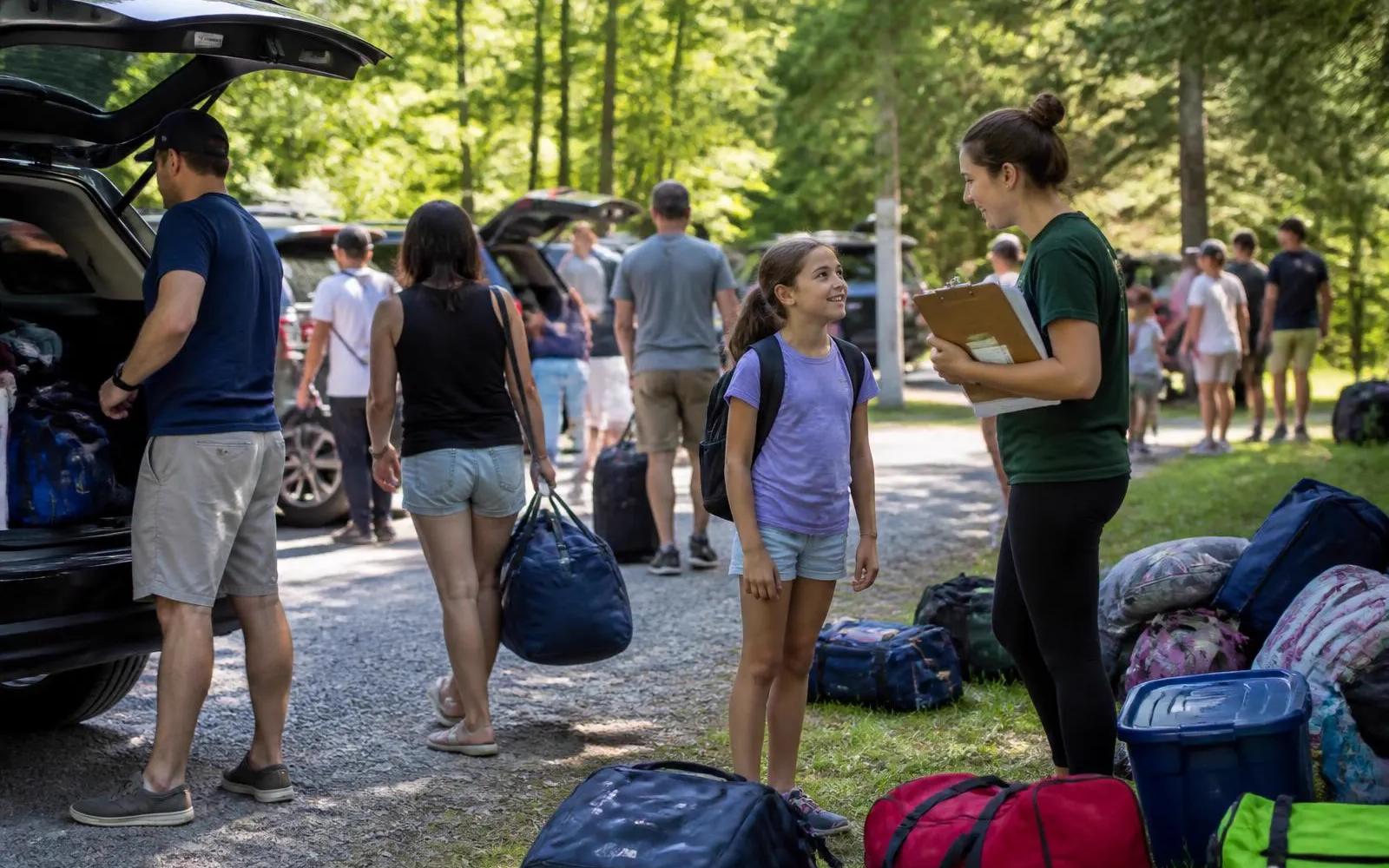
There's a moment, somewhere in the first hour of the first day, when a camp stops being a plan and becomes a living thing. The buses are early. A parent is crying harder than the camper. Two staff who were supposed to cover check-in are nowhere, the printer that worked yesterday has opinions today, and a seven-year-old has just announced, with total conviction, that he is going home now. You knew this was coming. You planned for it. And it still hits like a wave.
The first 72 hours set the tone for the entire season. Not because everything has to go right — it won't — but because how a camp absorbs the chaos of opening is the truest test of whether the systems underneath it actually work. Veteran directors know this. They don't try to prevent the wave. They get very good at riding it.
The arrival crush is a logistics problem pretending to be an emotional one
Drop-off looks like feelings — and it is — but underneath, it's flow. Cars or buses arrive in a clump, every family needs to be greeted, checked in, medically cleared, and pointed somewhere, and all of it happens in a window measured in minutes. When that flow jams, the feelings get worse. A parent who's been idling in a line for forty minutes is a more anxious parent, and an anxious parent makes an anxious camper.
The camps that handle arrival well tend to share a few habits. They stagger it on purpose, by last name or cabin or bus, rather than letting everyone hit the gate at 9:00 sharp. They put their warmest, most unflappable people at the very first point of contact, because the first face a family sees calibrates the whole day. And they over-staff the opening and under-staff the afternoon, knowing the crush is front-loaded and the lull will come.
The single most underrated move: a clear, visible answer to the question every arriving family is silently asking — where do I go and who do I talk to? Signage, a person with a clipboard and a real smile, a map that a frazzled parent can read in three seconds. It's unglamorous. It prevents more opening-day friction than almost anything else.
Homesickness has a schedule, and it isn't day one
A thing experienced directors know that new ones learn the hard way: the hard moment usually isn't the goodbye. Day one is adrenaline. There's a bunk to claim, names to learn, a whole new world to inspect. The wobble tends to come later — the second night, the third morning, the first quiet stretch after the novelty wears off and a kid suddenly remembers their own bed.
This matters operationally because it means your staff's readiness can't peak at drop-off and fade. The counselor who nailed the cheerful welcome also has to be the one, two nights later, sitting on the edge of a bunk at 10pm with a kid who can't sleep. Day camps feel a compressed version of the same arc — the Monday excitement, the Wednesday "do I have to go back" — and school and sport camps get their own variant, often wearing the mask of "I'm bored" or "my stomach hurts."
The fix isn't a trick. It's preparing staff for when the wobble lands so they're not caught flat, and giving them a few real tools — a routine, a job to do, a connection to one other kid — rather than a pep talk. Homesickness handled well in the first 72 hours rarely becomes a phone-call-home in week two. Handled poorly, it compounds.
Your staff are also new here
It's easy to forget, in the swirl of campers, that your team is having its own first 72 hours. Even returning staff are re-learning the rhythm; new hires are running on a few days of training and a lot of nerves. They're tired before the campers arrive. They're figuring out the radios, the schedule, the dozen small procedures that live in your head and haven't fully made it into theirs.
The opening days are where the gap between trained and confident shows up. A counselor can pass every training module and still freeze the first time two things go wrong at once. The directors who get this build in early, low-stakes reps — a practice run of check-in before the buses come, a clear "who do I find when X happens" chain, a visible leadership presence in the first days so staff aren't improvising alone.
And they watch for staff burnout starting now, not in July. The adrenaline of opening masks exhaustion. The crash comes a few days later, right around the time the campers are settling in and the team most needs to be steady. A director who protects a few staff breaks in the first week is making a deposit against the week-three slump that hits every camp.
The systems either hold or they don't
Opening is when a camp finds out the truth about its own operation. The registration data that looked fine in May reveals its gaps when a family arrives and their forms aren't complete. The medication process that made sense on paper meets a line of parents holding Ziploc bags. The check-in flow you designed gets stress-tested by reality in about eleven minutes.
This is worth saying plainly, because it's the most useful thing in this whole piece: the first 72 hours are the best diagnostic your camp gets all year, and you will forget most of what you learn by September. In the moment, you'll notice exactly what's broken — the form nobody filled out, the bottleneck at the nurse's station, the schedule that fell apart by lunch. Then the season swallows it, and by the time you have hours to fix things in the fall, the specifics have gone fuzzy.
So the move is almost embarrassingly simple. Keep a running note — your phone, a clipboard, whatever survives the week — of every "we should fix this" that surfaces in the opening days. Not to solve it now. Just to remember it later, when you actually can. The camps that improve year over year are usually the ones that wrote down what hurt while it still hurt.
Riding the wave
None of this is about achieving a perfect opening. There's no such thing, and chasing it just makes everyone tense. The buses will be early or late. Something will break. A kid will cry and then, twenty minutes later, be deliriously happy in a way that makes the whole thing worth it.
The directors who've done this a hundred times aren't calmer because they've eliminated the chaos. They're calmer because they've made their peace with it — they've built the systems to absorb it, prepared their people for the parts that always go sideways, and learned to trust that the wave, every single year, eventually sets the camp down gently on the other side. Then it's summer. The reason all of it exists.
Welcome back. Hope the buses are on time.
CampBuzz covers the companies, tools, and economics of the camp industry.
Author
Maggie HollowayEditorial byline, CampBuzz
Maggie Holloway covers buyer guides and industry reporting for CampBuzz: the questions worth asking, the fine print worth reading, and the ownership changes worth knowing about before you sign. CampBuzz does not rank vendors. Some CampBuzz articles are written with AI assistance.