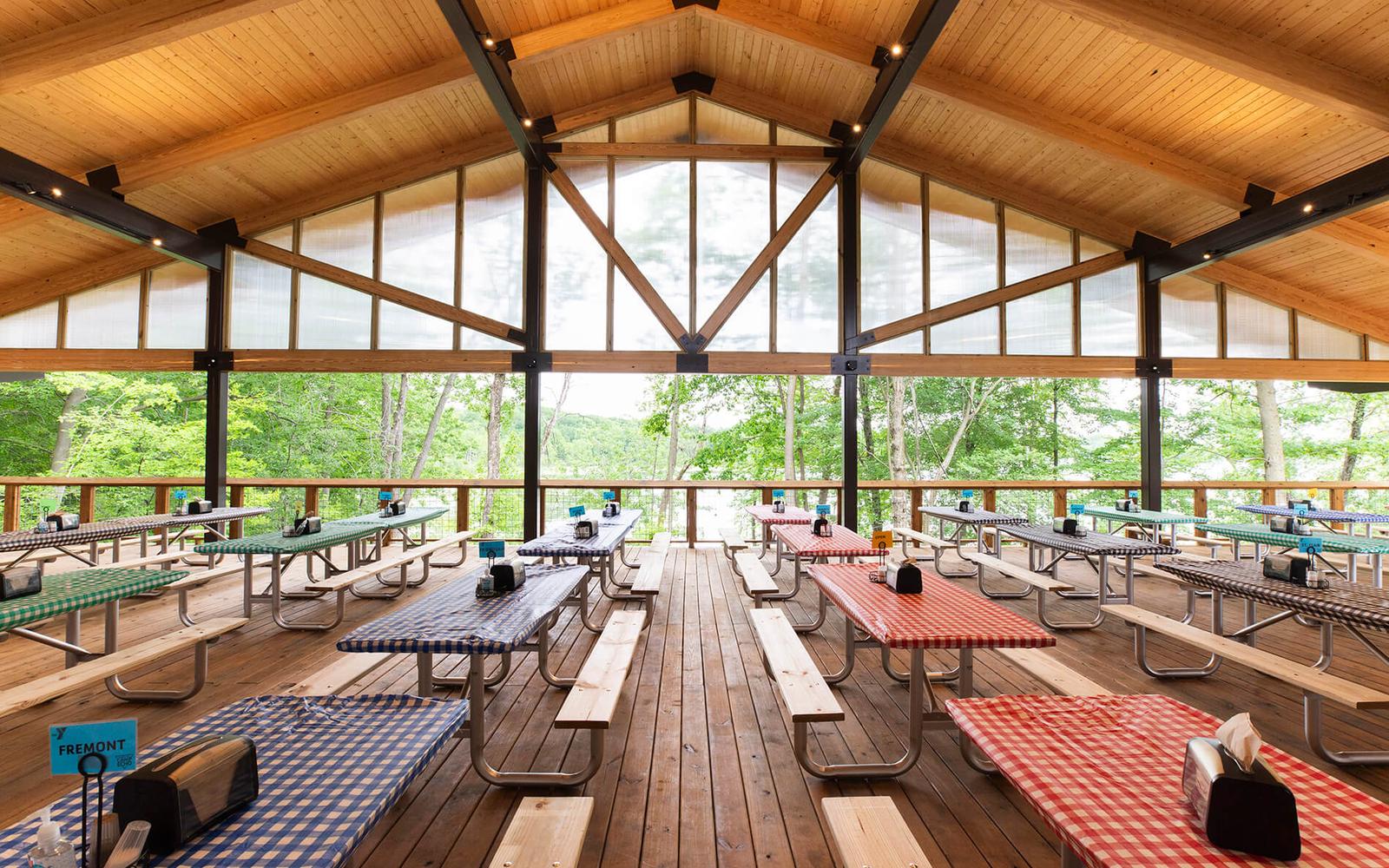
It’s 6:42 on an August evening and the dining hall smells like floor cleaner, wet plywood and one abandoned bowl of cereal.
The campers are gone. Most of the staff are gone. A box fan is pushing warm air from one side of the room to the other without improving either side. On a bench near the door sits a grey hoodie that has survived every lost-and-found announcement and now appears to own the building.
You are tired enough to believe you will remember everything.
You will not.
The final stretch of camp produces a dangerous kind of confidence. You can still hear the cabin that would not settle. You know which shower backed up after every heavy-use period. You remember the parent conversation that started politely and ended in a parking lot. The whole season feels close enough to touch.
Then September arrives. The details flatten. By the time winter planning begins, “the waterfront radio kept cutting out near the path” has become “check radios.” That is not a maintenance note. That is a small cry for help.
August close-out is the work of catching the season while it is still specific.
Write down the irritating version
A useful season note should be slightly annoying to read.
“Arts and crafts needs attention” asks your future self to reconstruct a summer from mist. Which sink? What attention? Was the problem storage, supervision, ventilation, cleanup or the fact that every bottle of glue migrated into the same drawer?
Write the note as if the person reading it was not there. Because, in a meaningful sense, you were not there either. Winter You is rested, optimistic and wearing shoes that have not been wet for twelve consecutive hours. Winter You will underestimate everything.
Record the location. Record when the problem appeared. Name the program period or operational moment that exposed it. Include the temporary fix, especially if the temporary fix quietly became policy.
That last category matters. Camps are excellent at solving a Tuesday problem with a milk crate, duct tape and a staff member named Eli. The danger arrives when the solution works well enough to stop feeling temporary. By closing day, the milk crate has a laminated sign.
Take the sign down. Keep the lesson.
The staff debrief needs friction
A staff debrief can become a warm bath of general agreement. Communication could improve. Training felt rushed. Days off were complicated. Everyone nods. Someone eats the last granola bar. Nothing survives.
The useful material is usually hiding inside disagreement.
One counselor thought the evening program transition was chaotic. The program director thought it was fine. Good. Ask them to describe the same transition from where they stood. One saw campers waiting without direction. The other saw units arriving outside the planned window. Now you have an operational problem rather than a mood.
Do not make every departing staff member sit through a grand summit. Exhausted people become ceremonial. They say what closes the meeting.
Catch observations in smaller settings while the physical memory remains: walking back from the ropes course, clearing staff housing, stacking benches after the final meal. Ask about the place where the day repeatedly snagged. Ask which instruction changed depending on who was on duty. Ask what staff learned too late.
Then document the answer yourself. A conversation is not a record.
Praise belongs in the close-out too. Not as a morale garnish, but as operational evidence. If a unit leader consistently ran clean departures, write down what that person actually did. If health center handoffs stayed clear during busy periods, capture the sequence. Good practice disappears just as easily as bad practice, particularly when everyone assumes it was obvious.
It was not obvious. Someone made it happen.
Walk the site before it becomes scenery
By late August, you have stopped seeing camp.
The bent screen door is simply the bent screen door. The extension cord has been routed around the same table for so long that it appears to be part of the electrical plan. A handwritten allergy reminder is still taped inside a cabinet because everybody who opens that cabinet already knows what it says.
Walk the property with fresh eyes, even if you have to borrow them.
Bring the person who cleans the space, repairs it, opens it each morning or locks it after dark. The people nearest the work know which problems recur. They also know which complaints are merely loud.
Photographs help when they preserve context. A close-up of a cracked board tells you there is a cracked board somewhere in the known universe. Step back. Include the building, corner, trail junction or bunk. Label the image before your camera roll fills with indistinguishable beige surfaces.
Look beyond repairs. Closing is also when you can see the operational shape of a place. Where did bags pile up? Which entrance became the default even though it was not intended to be? Where did campers wait in the rain? Which storage area required an adult to perform archaeology every afternoon?
Facilities notes and program notes often describe the same problem in different accents. Put them together before filing them into separate folders where they can live peaceful, useless lives.
Close the records, not the questions
August generates paper with remarkable stamina.
Medication documentation, incident records, attendance material, transportation changes, staff paperwork, purchasing notes, parent correspondence and program logs all arrive with different owners and different ideas about what “finished” means.
Close-out needs a named home for each record and a clear status. Complete. Pending. Referred. Waiting for an outside document. Needing follow-up. The exact labels matter less than the distinction between finished and sitting in a pile that looks finished.
Do not rely on inbox memory. An email thread can feel resolved because the last message was polite. Check the action underneath it.
The same goes for parent follow-up. If you promised a call, record the promise. If a concern was handed from a cabin leader to a division head and then to the office, make sure the handoff reached an endpoint. Summer communication often travels by proximity. Post-season communication does not. The person who could clarify the matter may already be driving home with half the answer and somebody else’s water bottle.
Some questions should remain open. That is honest. Mark them as open and preserve what is known. False closure is tidy until January.
Inventory is a story about use
Counting objects is only part of inventory. The more useful question is what happened to them.
A shelf can look full while holding equipment nobody chose all summer. Another can look empty because the useful items were constantly in circulation. If you record only what remains, you miss the season’s behavior.
Ask program staff what wore out, what disappeared early and what was repeatedly borrowed from another area. Note substitutions. The basketballs used for an improvised game may explain why the athletics shed never had enough basketballs. The dining hall pitchers that migrated to cabin porches did not vanish; they changed departments without paperwork.
Condition matters too. “Present” covers an ambitious range, from ready for use to technically still shaped like a canoe paddle.
Store equipment with the reopening decision attached. Clean and ready. Repair before use. Replace. Review. Otherwise spring begins with a scavenger hunt led by people who did not pack the room.
And label the mystery bin. Every camp has one. Cables for departed electronics. Keys to uncertain doors. A whistle attached to a lanyard from an event nobody recalls. Left alone, the bin does not shrink. It becomes institutional.
Some work should wait
Close-out urgency can turn into indiscriminate motion. That is how you end up rewriting staff training while still finding socks behind bunks.
August is for capturing evidence, securing the operation and completing time-sensitive follow-up. It is not always the moment for solving every structural problem the season revealed.
Big program changes need distance. So do staffing model decisions, schedule redesigns and revisions driven by a single dramatic week. Record the case while it is fresh. Preserve examples. Identify who should be part of the later decision. Then leave room between the summer and the verdict.
Memory fades, but emotion also cools. You need the first without being governed by the second.
Create a holding place for work that waits: policy review, training changes, capital needs, program questions, hiring notes. Give each item enough context to be useful when it returns. “Revisit check-in” will produce a blank stare. “Review the point where health forms, luggage and cabin assignments converged at arrival” brings the whole traffic jam back.
The quiet season should contain judgment. August should supply the evidence.
Leave a trail for the person who opens camp
You may believe you are closing camp for yourself. You are closing it for whoever arrives first.
That person might be you, standing in a cold office with a ring of unlabeled keys. It might be a returning staff member who remembers the broad outline but not the shutoff sequence. It might be someone new, discovering that the printer requires encouragement and the back storage door only closes when lifted slightly.
Leave opening notes where the work happens. Which buildings were fully cleared. Which supplies were moved. Which equipment was sent out. What remains plugged in, shut down, drained, locked or awaiting service. Avoid private shorthand unless you enjoy receiving messages from your past self that read “deal with lodge thing.”
Close-out is not an administrative epilogue. It is the first draft of next summer.
That changes the standard. You are not trying to preserve every detail. You are preserving the details that will affect a decision, a repair, a conversation or a morning when campers are already walking toward an activity area.
The grey hoodie can stay until the final lost-and-found box is sealed. Some mysteries are seasonal.
It’s 6:42 again, months from now, and someone is unlocking the dining hall. The note you left in August is part of the building now.
Author
Denny MarshEditorial byline, CampBuzz
Denny Marsh covers camp operations for CampBuzz: what happens on the ground during a season, and the parts the brochure leaves out. Some CampBuzz articles are written with AI assistance.